
Valuing Community · Case study · Stockland Fair, June 2025
Uncle Tacko
Dr Tony Lidington · Promenade Promotions Ltd
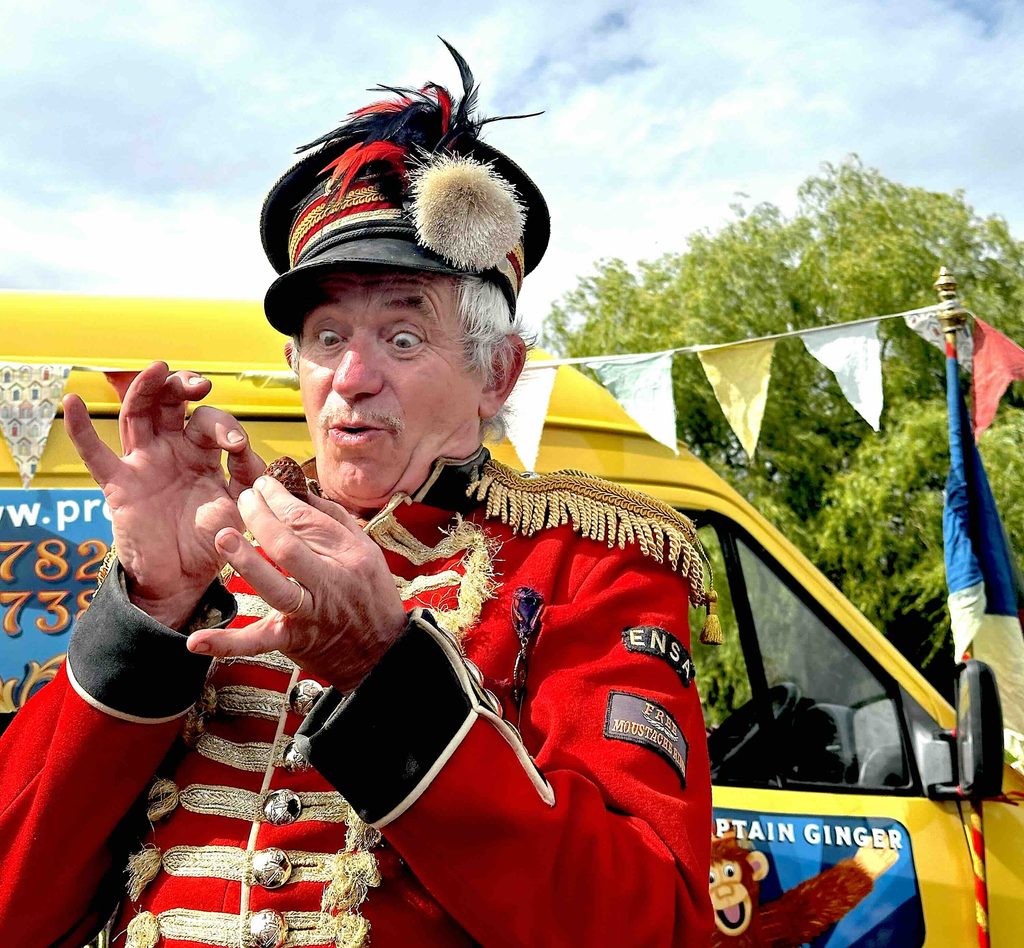
Uncle Tacko is the stage persona of Dr Tony Lidington, who has performed flea circuses and other vernacular popular entertainment at fetes, fairs, agricultural shows and festivals for 43 years from the back of his wagon. As he says: “I like to think I provide the extraordinary in ordinary places.” He trades through Promenade Promotions (Prom-Prom) Ltd, a not-for-profit company limited by guarantee. For Uncle Tacko, his shows represent a cultural experience “that’s grown locally for local people, by local people, informed by professionalism.”
He also has a PhD in itinerant British performance and taught drama at the University of Exeter. His research interest is vernacular forms and what they reveal about British identity, particularly after Brexit – in Uncle Tacko’s words: “Brexit fractured the contract between different communities of different opinions, and Covid fractured the relationship of people with each other and public space.”
Uncle Tacko’s view on the value of traditional British popular culture
- A crowd (a ‘non-stratified audience’) becomes a “congregation”. Strangers start as a loose public and end up laughing together and managing each other’s behaviour, teaching them in real time how to live as a community through modelled behaviour, not instructions and rote. “They’re a general loose public at the start, but watching the show they become part of a congregation… What we do in events like this is learn as a community how to be a community.”
- Everyone is in. He works with people with dementia, learning difficulties, behavioural issues or limited English. “I want the 3-year-old there, the 10-year-old delinquent, and the PhD graduate.” It is inclusion by design. There are also opportunities for puppetry training for people who have not succeeded academically.
- Children learn how to behave with others. The show deliberately invites disruption, for example from children aged roughly 9 to 12 testing their power over the space. Through dialogue and tongue-in-cheek exchange, the rest of the audience helps guide them: to model and manage behaviour, so the crowd becomes a self-regulating group.
- No silos. Farmers, teenagers, parents and grandparents share the same show and the same experience. This is an intergenerational levelling experience. As Uncle Tacko says: “I want the 3-year-old to be there, I want the 10-year-old delinquent to be there, and I want the PhD graduate to be there. They’re all the same; they’re all part of this community.”
- Summer fairs and shows give the year a rhythm as they repeat as seasonal benchmarks. Fairs give a purpose to shared public space and something to talk about “for the rest of the summer”. As Uncle Tacko says: “It provides a rhythm to the year; it provides a purpose to the communally held space….Those connections with the past, those deep roots, kind of ecological, if you talk about rhizomic growth, maybe there’s something in that to learn from.”
- Shows are a form of emotional release and shared experience: grief, ludicrousness, fun held together “without causing offence”, which could help us to become more tolerant of different views.
The show is carefully designed: colours, smells, engagement methods are all chosen to work across three generations at once. The Uncle Tacko shows how a one-person social enterprise creates intergenerational cohesion, informal social learning and inclusion at scale, while almost none of that value is surfaced by current funding, governance or measurement systems. This case is an example of “the value no one sees”: high reach and strong social effect, with no formal measurement at all.
Why the value stays hidden
- Too small to measure itself: One person does the delivery and also “the invoicing at one in the morning”. There is no spare capacity for impact reporting, as measurement would compete directly with delivery. Knowledge and networks sit with one person (this also relates to the fragility of being a sole trader and ensuring how these crafts are passed to the next generation). The only metric he generally uses (informally) is “the amount of smiles we got for the amount of money we got.” Any framework that relies on self-reported organisational data will miss the value generated by these activities.
- Legal form acts as a gatekeeper to funding and accessing support: A lot of funding is only open to charities, so a small not-for-profit company misses out even when its aims are the same. PromProm is purposefully not a registered community enterprise because the benefits vs. the administration doesn’t stack up for the business. Charity or CIC status is judged not worth the administrative load for a small company, so the organisation is shut out of funds its work would qualify for.
- Not counted as “the arts”: Funding favours large city institutions. Traditional travelling entertainment falls outside the funders’ idea of culture. Arts funding tends to favour building-based and metropolitan institutions. Vernacular, itinerant popular entertainment sits outside what counts as “the arts”, although it reaches, despite high participation by unstratified audiences, larger than many middle-scale venues on the same day.
- Measures of value are disconnected from the value traditional vernacular culture generates: The emotional release and experience of being immersed in a collective cultural experience are essential and often overlooked. “The commercial world simply thinks about things in terms of profit and not about value. When I used to apply for arts funding, I used to say the amount of smiles that we got for the amount of money that we got. And it’s not just that; it’s also about tears. It’s about playing to a granny and a grandchild, and the grandchild’s crying at the end of the day, and you can cheer them up. That’s worth tens of thousands of pounds.”
- Support networks have gone: Peer networks like the West Yorkshire community arts cluster he once led no longer exist. Practitioners “burn out, give up, or are driven out.”
- A lack of self-sustaining spaces that can support the repeated practice of things young people learn and experience throughout the year, beyond seasonal benchmarks: “The kids who make wonderful sounds with a band here, they need to be able to do that when they go back to the youth club on Friday night, this coming Friday. What are they going to do then?”. The fair creates a moment but youth services, schools, Scouts and churches carry it forward. Cuts to those services break the regenerative value chain.
- A lack of hybrid resourcing that doesn’t rely on volunteers or grant funding alone: Former commissioning clients (schools, housing associations, town markets, local authorities) have all cut spending. As he says, “It doesn’t cost a lot of money. But it does cost money, and you can’t just rely on the tertiary sector people volunteering, because everybody’s strapped for cash and for time.”
- Technology is not a substitute for human encounter: Uncle Tacko argues that savings sought through technology miss the wellbeing value of real-time, face-to-face, intergenerational contact that is measured, or even surfaced in the first place. The space for analogue encounter is vital to promote connective bonds and keep social and other forms of value alive.
The central lesson is that proportionate recognition, not more reporting, is what would make this kind of value visible.
What would help
- Light-touch measures for micro organisations, such as audience reach, age/intergenerational mix and repeat attendance, that count towards social value without a full SROI.
- Funding based on purpose, not legal form, so asset-locked/not-for-profit companies limited by guarantee can apply.
- Ring-fenced arts money for local and district authorities, which links to Local Growth Plans and devolution deals.
- Evaluating continuity, not just events, to test whether event participation carries into ongoing provision of other services in line with the Green Book’s focus on place-based and distributional value. The most distinctive evidence sits in regenerative value. A test of lasting value is whether children who played in a band at the fair can keep doing so at the youth club “this coming Friday”. That is a concrete, measurable indicator of continuity that current event-based evaluation misses.
- Rebuilding peer support networks like the former community arts clusters to reduce isolation and burnout.
Value Created Across Multiple Dimensions
Analysing the Value of PromPromLtd through the lens of the VCSE Value Typology
| 1. Monetary & Cost-Benefit | ‘It doesn’t cost a lot of money. But it does cost money… you can’t just rely on the tertiary sector people volunteering.’ Tony delivers high reach at low cost: around 800 people in a day, on a turnover of £60–70k a year. His only measure has been ‘the amount of smiles… for the amount of money’. The unmeasured value is the cost per head compared with subsidised venues, and the wellbeing and youth services that community events may reduce the need for. |
| 2. Recognition & Appreciative Value | ‘I have more people here watching me today than most middle-scale venues will have today, so why is it that I don’t get the same…’ After 43 seasons, the character is well known and loved locally, and people talk about the show ‘for the rest of the summer’. Yet the work goes unrecognised by arts funders. The recognition gap is between how much audiences value it and how little institutions do. |
| 3. Capitals Perspective | Social capital: ‘There aren’t any silos… the farmers, the youngsters, the teenagers, the yummy mummies, the dads with pints of lager. They’re all here.’ Human capital: ‘It teaches people transmittable skills, relatable skills.’ Cultural capital: vernacular forms such as flea circuses and Punch and Judy that ‘inform British society’. The show builds bridging social capital across groups who rarely mix, keeps a living heritage going, and develops communication skills in performers and audiences. |
| 4. Community Assets & Ownership | ‘It provides a rhythm to the year, it provides a purpose to the communally held space.’ The fair is a shared community asset that recurs every year. Tony links it to a wider set of anchors: church, Cubs and Scouts, youth clubs and schools. Many of these have been ‘reduced or farmed out’. The performer’s 43 years of skill is also a community asset, but nobody owns or protects it. |
| 5. Value Chain Perspectives | ‘Funding from school stops… housing association stops… markets in town stops… local authority stops. We were their clients.’ The chain of commissioners that used to book popular entertainers has fallen apart. Tony’s son is entering the trade only because he has inherited his father’s connections: ‘most young people don’t’. The pipeline for new practitioners depends on family networks, not open pathways. |
| 6. Personal Value & Intrinsic Objectives | A lot of mainstream jobs are ‘[not] a way to heal the world or heal your soul.’ ‘It is empowering for them to try and control… the space.’ For Tony, the work is a vocation, not a job. For audiences, it builds confidence, especially for children aged about 9–12 and for people who have not done well academically. The personal cost is visible too: ‘until we fall down and are ill… burn out, give up, or are driven out’. |
| 7. Regenerative Value | ‘What we do in events like this is learn as a community how to be a community.’ ‘I think our work helps to heal those things… those deep roots, kind of ecological… rhizomic growth.’ The show turns a loose public into a ‘congregation’ that regulates itself, which is a positive cycle of shared behaviour. Tony sees it as repairing the fractures left by Brexit and Covid. His test of lasting value is whether children can keep playing music ‘at the youth club on Friday night’. |
| 8. Governance & Culture | ‘We’ve never been a charity nor a CIC because the amount of work that entails just isn’t worth it.’ ‘I have a board, an advisory board… they are supportive. That’s all they do.’ Light governance suits a one-person company, but it shuts PromPromLtd out of limited funding criteria. Formal governance models cost a lot of administration without adding value at this scale. |
| 9. Policy Influence & Systemic Outcomes | In “Cultural policy… there’s a lot of lip service, but I don’t see it translated on the ground.’ Tony names several systemic failures: arts funding focused on big metropolitan institutions, legal-form barriers, and the loss of support infrastructure such as community arts clusters. He proposes ring-fenced arts funding given to local and district authorities. He has strong policy views but no channel to act on them. |
Uncle Tacko completed the Valuing Community Mapper to surface these value contributions (developed by Valuing Community as part of research funded by the British Academy). This is what he thought of the mapper:
” XXX”
Notes
ENSA (Entertainments National Service Association) and CEMA (Council for the Encouragement of Music and the Arts) were the wartime bodies from which the Arts Council of Great Britain was formed in 1946. ENSA supported things like concert troops, variety entertainment and popular entertainment. Uncle Tacko suggests that post-war cultural funding tended to support mainstream arts and culture rather than traditional, popular culture such as his.
A note on social accounting
In the interview, Tony says that a Gordon Brown-era plan to value community impact was “ditched overnight”. Under the Labour governments of 1997–2010, the Office of the Third Sector was set up in the Cabinet Office in 2006. From 2007, it and the Scottish Government funded work on a consistent method for charities and social enterprises to account for their social impact. The result was the Cabinet Office’s Guide to Social Return on Investment (2009).
After 2010, the coalition government renamed the Office of the Third Sector the Office for Civil Society, and central support for this work ended. Business Link and the regional development agencies were abolished in the same period, taking much of the local support for small enterprises with them.
The idea of social value continued through public procurement instead. The Public Services (Social Value) Act 2012 requires public bodies to consider social value when commissioning services. From 2021, the Social Value Model (PPN 06/20) has given social value at least 10% of the evaluation weighting in central government contracts. The Procurement Act 2023 moved tender evaluation from “most economically advantageous” to “most advantageous”. The SROI guide is still maintained by Social Value International and Social Value UK.
PPN 026, published in August 2026, replaces this model for central government procurements that start on or after 1 January 2027. It applies to contracts of £1m or more and raises the minimum weighting to 20% for contracts of £5m or more. It also narrows social value to two outcomes: good jobs and skills. Wider themes such as community cohesion, wellbeing and the environment are not explicitly part of the central government model.
As a result, social value measurement now works mainly through large contracts and supplier reporting. Nothing comparable has been rebuilt for micro organisations like Promenade Promotions. Much of the value this case study describes (intergenerational cohesion, shared cultural heritage, community ritual) falls outside the current definition.
The interview was filmed at Stockland Fair, East Devon, in June 2025 as part of a British Academy Policy Innovation Fellowship. The views expressed are those of the interviewee and are not reflective of endorsement by the publisher, partners or funders of this research.