

British Academy Policy Innovation Fellowship Activities Fund
Analysing how current policy frameworks for VCSE sector measurement affect community organisations’ ability to articulate their value. This project includes policy recommendations for more inclusive approaches to community valuation.
This project is part of the British Academy's Policy Innovation Fellowship Scheme. In partnership with Middlesex University and the British Academy Measuring Social and Cultural Infrastructure, Digital Society and Policy teams.
Developing value-ful digital infrastructure
VCSEs are Voluntary, Community and Social Enterprises with a social purpose that range from small community groups to larger charities and social enterprises, operating across various sectors but particularly well known for supporting environmental and social good (see PPN 11/20).
This research is assessing what value-ful digital infrastructure might look like to enhance a multi-dimensional understanding of value in the communities and how this can be integrated into existing and future solutions. It is being carried out by a former British Academy Policy Innovation Fellow Dr Amy Burnett. Her research involves gathering insights into the value of the VCSE sector and how this value is (or isn’t) being measured and understood by different groups and how a potential Value Mapper could support some of the challenges faced by the sector and those that support it, such as town and parish councils. It includes one-on-one interviews, focus groups and a Policy Lab to reflect on the findings and co- create solutions for policy and wider support measures to improve understanding of how the VCSE sector is valued.
The British Academy's Measuring Social and Cultural Infrastructure Framework
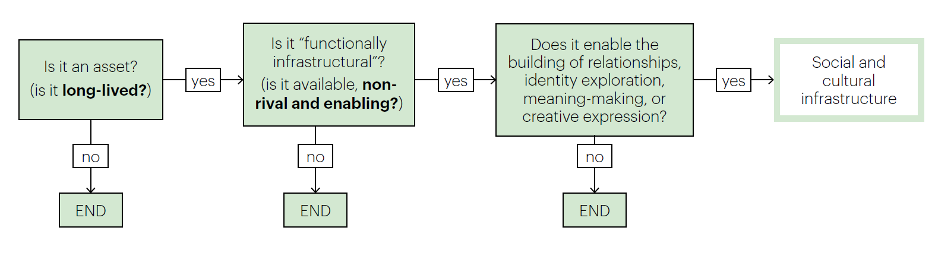
Measurement as a Process, Not a Product
Assets classed as social and cultural infrastructure demonstrate the same core characteristics as other types of infrastructure (roads, utilities, digital), while also making particular contributions to the social and cultural lives of communities.
Measurement should be seen as a process that at each stage considers how choices and decisions about what is measured and how reflects the needs of all involved.
Access the framework here.
Methodology
- Desk-based study: Review of publicly available documents to understand existing metrics and measures.
- Interviews with VCSEs and their supporters and local government
- Conducting a series of focus groups key themes with stakeholders and attending several relevant events
- Technical requirements for a VCSE Value Mapper
- Validating findings in Policy Lab
- Beta testing of the Value Mapper and testing by potential users
Research Questions: Unpacking VCSE Value
The research aims to answer several key questions to better understand and measure the contributions of the Voluntary, Community and Social Enterprise (VCSE) sector:
- How is ‘value’ currently measured? What specific metrics and measures are being used to capture the value and quality of services provided by VCSE organisations?
- Who uses these measures and how? How are these valuation approaches applied and interpreted across various stakeholder networks, including government bodies, funders, and the VCSE organisations themselves?
- Are current methods fit for purpose? Do the existing measures adequately reflect the multifaceted value that the VCSE sector provides?
- How is value negotiated? How do VCSE actors and their supporters justify, construct, resource, and assess outputs and outcomes?
- Do VCSE services offer system efficiencies? Does the way services are delivered through the VCSE sector lead to more effective interventions, potentially saving costs across other government departments like education or health?
- How can data practices be improved? What steps can be taken to enhance data collection and usage in a way that truly empowers the VCSE sector and its stakeholders?
Co-design process
The research aims to:
- Validate whether a multi-dimensional value typology developed during a British Academy Policy Innovation Fellowship is useful for different stakeholders who are from, work with, procure from or support VCSEs
- Identify which value dimensions matter most and which feel missing
- Understand existing measurement practices and pain points (and how the British Academy’s measuring social and cultural infrastructure framework might address these)
- Test accessibility of language and concepts (i.e. value ‘vs.’ impact)
- Gather user requirements for the VCSE Value Mapper tool
- Explore how small organisations could realistically use the framework/mapper tool
- Understand how to embed design preferences into policy and data systems
Contributions to the field
The project contributed to the field in various ways, by
- supporting the use of a value typology for understanding different types of value
- integrating exisiting frameworks to support VCSE sector value and community-led asset management (e.g. the British Academy’s Measuring Social and Cultural Infrastructure framework)
- integration with existing platforms and national-level data infrastructure (e.g. DCMS/ODI national open data standard for the volunteering sector)
Outputs

VCSE Value Mapper
The Value Mapper brings to life a framework to unpack a multi-dimensional assessment of value-ful measures to support decision-making.

Asset management – a value-ful approach
This tool uses the value typology and the BA’s Measuring Social and Cultural Infrastructure framework to help local councils navigate the asset transfer process to identify and amplify multiple values beyond economic valuations
Working Paper – value-ful digital infrastructure
This report summarises the techinical design for the Value Mapper and the methodology that informed its development. Includes policy and practice recommendation for a value-ful and integrated assessment of value, the impact economy and resilient place-centred action across all scales of government
Get in touch
Invitation to comment and steer outputs
If you are interested in testing the Value Mapper and related tools, please get in touch.