

BA British Academy Policy Innovation Fellowship
Analysing how current policy frameworks for VCSE sector measurement affect community organisations’ ability to articulate their value. This project includes policy recommendations for more inclusive approaches to community valuation.
This project is part of the British Academy's Policy Innovation Fellowship Scheme. In partnership with Middlesex University and the Department for Culture, Media and Sport.
Understanding the value of the VCSE sector
VCSEs are Voluntary, Community and Social Enterprises with a social purpose that range from small community groups to larger charities and social enterprises, operating across various sectors but particularly well known for supporting environmental and social good (see PPN 11/20).
This research is being carried out by British Academy Policy Innovation Fellow Dr Amy Burnett. Her research involves gathering insights into the value of the VCSE sector and how this value is (or isn’t) being measured and understood by different groups. It includes one-on-one interviews, focus groups (by theme and in different places), and workshops to reflect on the findings and co- create solutions for policy and wider support measures to improve understanding of how the VCSE sector is valued.
The research was carried out to enhance CSY’s evidence base to better support the growth and resilience of the VCSE sector and foster a strong civil society. This fellowship has developed and applied a robust framework for assessing the quality and value of services provided by the VCSE sector, comparing them to those offered by other sectors, such as the public sector.
This fellowship builds on previous DCMS-commissioned research regarding VCSE engagement in public services and reducing barriers to market entry. It complements this by focusing on data utilisation and communication to support resilient local economies, particularly how VCSEs and SMEs compete within the Government’s Social Value Model. A critical lens will be applied to the concept of “value” throughout this fellowship.
Methodology
- Desk-based study: Review of publicly available documents to understand existing metrics and measures.
- Interviews with VCSEs and policy and supporters
- Conducting a series of focus groups key themes with stakeholders and attending several relevant events
- Validating findings in workshops with DCMS and other government departments
- Informative Films/Podcasts: Production of short films or podcasts, drawing on interviews, workshops, and focus groups, to disseminate key themes and case studies via social media.
Research Questions: Unpacking VCSE Value
The research aims to answer several key questions to better understand and measure the contributions of the Voluntary, Community and Social Enterprise (VCSE) sector:
- How is ‘value’ currently measured? What specific metrics and measures are being used to surface the value and quality of services provided by VCSE organisations?
- Who uses these measures and how? How are these valuation approaches applied and interpreted across various stakeholder networks, including government bodies, funders, and the VCSE organisations themselves?
- Are current methods fit for purpose? Do the existing measures adequately reflect the multifaceted value that the VCSE sector provides?
- How is value negotiated? How do VCSE actors and their supporters justify, construct, resource, and assess outputs and outcomes?
- Do VCSE services offer system efficiencies? Does the way services are delivered through the VCSE sector lead to more effective interventions, potentially saving costs across other government departments like education or health?
- How can data practices be improved? What steps can be taken to enhance data collection and usage in a way that truly empowers the VCSE sector and its stakeholders?
Key Findings according to the Research Questions
How is ‘value’ currently measured, and what metrics surface VCSE service quality?
The research finds a fragmented landscape dominated by monetary and cost-benefit analysis — particularly SROI, which remains the default mode demanded by commissioners and policy-makers. Ratios of 3:1 to 10:1 are commonly reported, but stakeholders consistently note that the most meaningful dimensions — trust, community connection, personal transformation — resist this form of quantification. The typology developed through the fellowship identifies at least nine distinct valuation types in practice, ranging from monetary and capitals-based approaches through to governance, community assets, value chain perspectives, regenerative value, and policy influence. Existing frameworks such as the TOMs and Social Value Portal tools provide useful indicators but remain supply-chain-focused and can miss VCSE-specific modes of value creation.
Who uses these measures and how? How are valuation approaches applied across stakeholder networks?
The research reveals that different logics apply across stakeholder groups. Large private businesses have far greater resources to spend on understanding, measuring, and shaping social value, placing VCSEs at a structural disadvantage in procurement and commissioning contexts. Policy-makers and commissioners tend to privilege efficiency and value-for-money framings, whereas VCSE practitioners — particularly those with democratic governance and community accountability mechanisms — apply more holistic, experiential, and place-based understandings. Value is not simply measured but actively negotiated across these stakeholder networks, with the Social Value Act (2012) and the Procurement Act (2023) acting as contested passage points through which different actor logics collide.
Are current methods fit for purpose? Do measures reflect multifaceted VCSE value?
The central finding is that they are not. Social value has been described by a key research participant as a “loose and baggy monster” — flexible enough to be appropriated by almost any agenda, and therefore vulnerable to both co-option and dilution. Current frameworks systematically invisibilise dimensions such as shadow value, optionality, social capital, and regenerative value — dimensions that are precisely where much of the distinctive VCSE contribution lies. The typology is a direct response to this gap, offering a multi-dimensional framework that makes visible what conventional metrics miss.
How is value negotiated? How do actors justify, construct, resource, and assess outputs?
The research evidences a process of value construction that is deeply political. Planning and procurement systems act as arenas in which competing value logics are contested. VCSE actors often enter these arenas from a weaker position — facing resource constraints, skills gaps in recruiting trustees and staff, and difficulties meeting procurement criteria designed with private sector suppliers in mind. Yet the sector also demonstrates significant strengths: diverse and community-embedded leadership, higher growth rates than conventional enterprises, and a reinvestment logic that generates different modes of return. The sector’s hybrid organisational models generate innovative approaches to value creation but face barriers in being recognised and rewarded within mainstream commissioning frameworks.
Do VCSE services offer system efficiencies? Do delivery methods lead to more effective interventions?
The evidence points to yes, though this is poorly surfaced by current metrics. The regenerative value concept developed in the typology is particularly relevant here — it examines systemic conditions that enable positively reinforcing cycles of value creation rather than focusing solely on outputs and outcomes. VCSEs’ community embeddedness, reach into underserved populations, and place-based accountability give them comparative advantages in delivering more effective interventions, particularly in health and care contexts. However, reduced funding environments (50% of organisations reporting reduced funding post-COVID) and increased competition threaten sustainability of precisely these distinctive delivery approaches.
How can data practices be improved? What steps enhance data collection to empower the sector?
The research identifies several interlinked challenges: limited data distinguishing the VCSE sector from the private sector within procurement data; a digital skills gap and capacity constraints preventing consistent data collection; and poor local data accessibility for commissioners. Practical steps evidenced in the literature include the development of open-source standardised tools, CRM adoption, peer learning networks, shared data repositories, and feedback mechanisms embedded within commissioning relationships. The Valuing Community Mapper is positioned as a direct response to this challenge — a non-extractive digital tool enabling organisations to articulate multi-dimensional value without requiring costly consultancy, and designed to strengthen rather than supplant grassroots intelligence.
Learnings
The research identified systematic gaps between current measurement approaches and the full spectrum of VCSE value creation. While there is growing recognition of interconnections between social value and environmental outcomes, net-zero targets and community resilience, nature-based solutions and social infrastructure, policy and measurement siloes still prevent coordinated analysis of socio-environmental systems perspectives.
The research led to the development of a VCSE value typology that can be used to help frame policy interventions, value-ful monitoring, evaluation, accountability and learning systems at different scales and help to uncover what is and not being measured. The value typology developed through this research offers a framework for addressing these gaps by providing a comprehensive taxonomy that can be used to assess where current measurement approaches focus and where critical dimensions remain unmeasured.
This comparative analysis reveals that while monetary and efficiency measures dominate current frameworks, dimensions such as regenerative value, community ownership, and personal/intrinsic value creation receive limited systematic attention
The framework also highlights how different stakeholder groups prioritise different aspects of value creation, suggesting need for measurement approaches that can accommodate multiple perspectives while maintaining coherence across the sector. For example, policy-makers often focus on efficiency and policy influence outcomes, while community organisations prioritise personal value and community assets perspectives.
Outputs

The value typology offers a framework to unpack a multi-dimensional assessment of value-ful measures and key lines of enquiry that can support understanding of values from different perspectives.

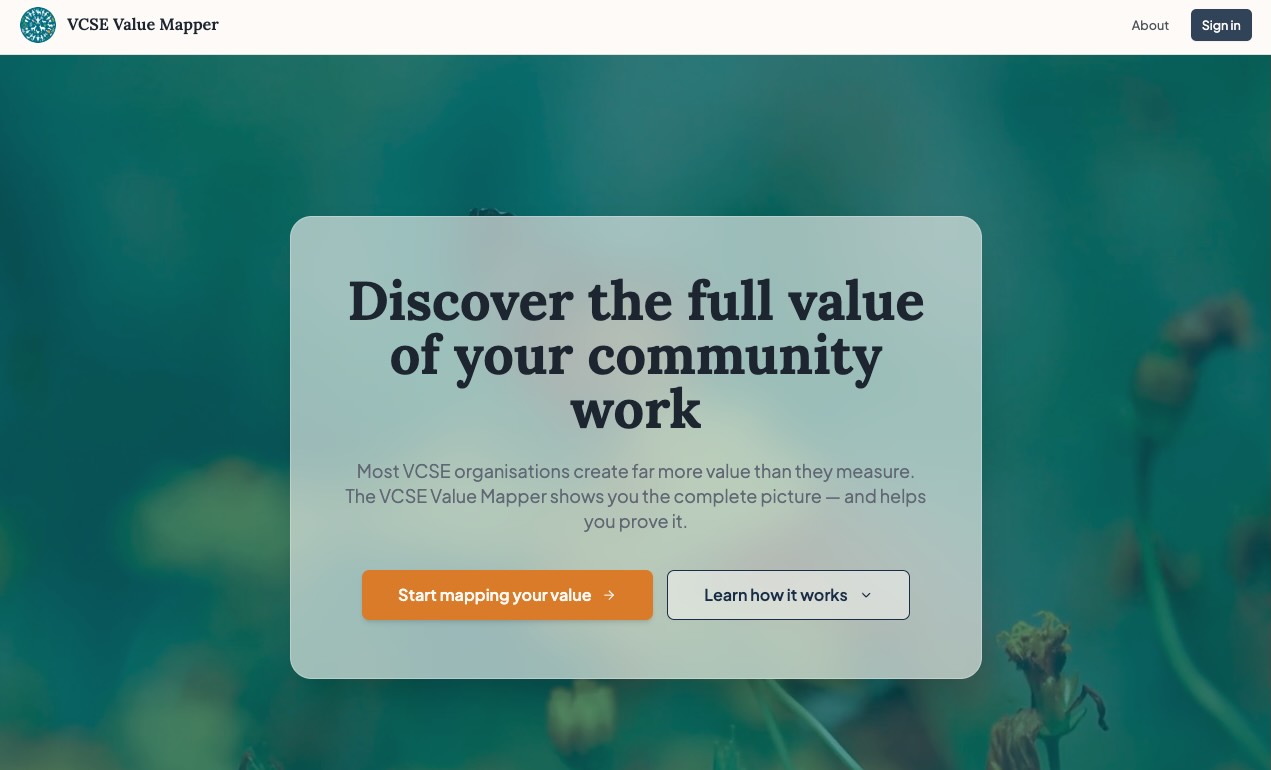
Test the Valuing Community Mapper for yourself to understand how your organisation surfaces different forms of value, what isn’t often counted and how you can amplify your value story.
Get in touch
Invitation to comment and steer outputs
What is the best output type e.g. for the consolidated database of indicators and evidence-based, according to agreed typology characteristics? Do the ideas suggested look helpful? Who would we need to involve to make it happen? Does it duplicate/enhance what others are working on?
Feedback welcome
-
Value Typology: Feedback from DCMS/policy colleagues welcome.
-
Value Mapping tools: Developing a VCSE Value Mapper, VCSE Framework selection tool, VCSE Data Sources Discovery tool etc.
-
Methods: actually used, what do you think of the SWOT/PESTLE+ analysis?
-
Future suggestions for methods: It was not possible for the fellowship to cover methods beyond those actually employed due to time and resourcing considerations.
-
Reflective questions for policy-makers e.g. understanding resilience and disadvantage. Are these helpful?